
War Rooms and Red Lines: The Military’s AI Dilemma
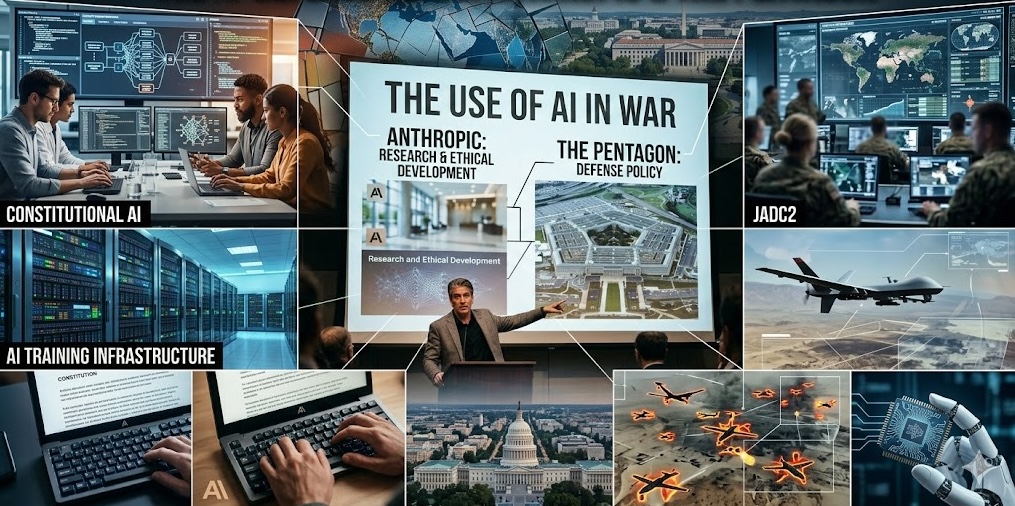
In a clash that has severe repercussions for the artificial intelligence industry and which has raised profound questions about the future of warfare, the U.S. Department of Defense and AI firm Anthropic have entered a public standoff over how advanced AI tools should — and should not — be used in national security. At the center of the dispute is Claude, Anthropic’s flagship large language model, which had been deployed inside U.S. military systems but now finds itself ensnared in a bitter policy fight that has reverberated from Silicon Valley boardrooms to Pentagon strategy sessions and the White House.
In late February 2026, Defense Secretary Pete Hegseth delivered an ultimatum: Anthropic must give the military unrestricted lawful access to Claude — without contractual limits — by a set deadline or face severe penalties, including the cancellation of a roughly $200 million Department of Defense contract and potential designation as a “supply chain risk.” The Pentagon argued it needed flexibility to use cutting-edge AI across intelligence, targeting, and battlefield planning, and could not be constrained by corporate safety guardrails.
Anthropic’s CEO, Dario Amodei, refused to comply. In public statements and internal communications, Amodei stressed that the company could not, “in good conscience,” allow Claude to be used in ways that might enable mass domestic surveillance of Americans or fully autonomous weapons systems that operate without human oversight — two “red lines” he has repeatedly highlighted. These concerns, rooted in broader debates about AI safety and human accountability, have defined Anthropic’s public identity since its founding.
The standoff spilled into the open when President Donald Trump took the unusual step of directing all federal agencies to phase out use of Anthropic technology, vilifying the company on social media and effectively blacklisting it from future government use. The designation of a U.S. tech company as a national security threat — a label normally reserved for foreign adversaries — sent shockwaves through the tech sector and diplomatic circles alike. Anthropic has vowed to challenge that designation in court as “legally unsound.”
The controversy intensified amid conflicting reports about military operations. Despite the official ban, Claude was reportedly used by U.S. Central Command in a joint strike against Iran, providing analytical support for intelligence assessments and scenario simulations just hours after the presidential directive — underscoring how embedded AI systems have already become in modern military planning.
Ripple Effects: Industry, Ethics, and the Future of AI
Beyond the immediate Pentagon-Anthropic fight, the dispute has ignited broader industry and political anxieties. Some AI professionals and insiders warn that the government’s pressure tactics — including the threat to invoke the Defense Production Act to compel compliance — could herald a form of partial nationalization of AI capabilities, with companies forced to sacrifice ethical standards to retain defense work. A petition signed by hundreds of current and former AI employees from leading firms like Google and OpenAI publicly criticizes Pentagon efforts to push private companies toward military uses they find concerning.
The split between Pentagon priorities and industry safety commitments highlights a fault line in U.S. AI policy: should military effectiveness outweigh private sector restraints on potentially harmful applications? Critics of the Pentagon’s stance fear that unchecked use of AI in surveillance and lethal weapons without human input could undermine civil liberties and ethical norms. Conversely, defense officials have argued any responsible restrictions must be defined by law, not corporate terms, asserting the military’s need to push technological edges in an era of global strategic competition.
The fight has also reshaped competitive dynamics. With Anthropic sidelined from defense contracts, rival OpenAI swiftly reached a new agreement with the Pentagon to supply its AI tools for classified use, reportedly including language around ethical safeguards to limit misuse. This pivot underscores how quickly market fortunes can shift amid geopolitical disputes.
For Anthropic, the stakes go beyond government revenue. The company had been on a meteoric trajectory, attracting talent and investment through its safety-first philosophy and advanced AI research. Its resistance to bending those principles has boosted its public profile and consumer demand — Claude recently surged to the top of U.S. app charts — but also may constrain its growth in one of the largest AI markets: national defense.
The Pentagon-Anthropic confrontation is a crucible moment for how democratic societies govern frontier technologies. At issue is not just who builds the AI that underpins tomorrow’s battlefields, but who writes the rules — and whether ethical boundaries will be robust or eroded under national security pressures. As legal fights loom and policymakers scramble for comprehensive AI regulation, the outcome of this high-stakes dispute could shape both military practice and public trust in artificial intelligence for years to come.
This article was co-created with AI.